
Going international: designing for the German Market
Introduction: Problem Statement
In 2022, Bright Network took their first steps toward international expansion by entering the German market. Germany was chosen due to a significant overlap in clients operating across both the UK and German markets, making it a logical next step for international growth. We launched the same product offering that had been successful in the UK, hoping the same would be true for Germany.
However, despite this strategic alignment, the launch did not attract the volume of German students and graduates that had been anticipated. Sign-ups and engagement fell well below expectations, indicating that simply copying the UK experience was insufficient for this new market. As a result, we needed to understand why the launch had underperformed and identify how we might better appeal to German students and graduates.
Our primary objectives were to increase the number of marketable members by 8,000 new sign-ups and to double post sign-up engagement.
Researching the German Market
At the point of launch, no dedicated research had been conducted into the German student and graduate market. To address this gap, we began by speaking directly with German students and recent graduates to understand their university education, work experiences, and career motivations.
Through user interviews and desk research, we learned that:
- Degree programmes in Germany typically last longer than in the UK, often spanning four to six years rather than three.
- ‘Werkstudent’ jobs are common which give students practical experience alongside their academic studies
- German students generally do not pay tuition fees and often receive government support to help cover living costs while studying.
To validate and broaden these insights, I also ran a survey sent to German students and graduates. This survey asked questions on job website expectations, the Bright Network brand and attitudes towards job searching in general.
- 0% were using Bright Network, and 75% assumed based on the name that it was a type of social networking platform
- 87% were happy to use competitor platforms like LinkedIn or Stepstone because they trusted their offering and liked the additional features such as online CVs, and direct lines to recruiters
- 56% wanted personal job recommendations based on their skills
- Most interestingly, we learned that 79% feel confident getting an entry level role after graduation (vs. 58% as we discovered through a different survey ran in the UK)
“I am not sure what my dream job is going to look like, but it would be nice to somehow get a job that fits my expectations right away.”
•
German student, 25 yrs old, user interview
These findings suggested a fundamentally different mindset. With less financial pressure and earlier access to relevant work experience, German graduates appeared to have greater freedom in their career decision-making. Rather than urgently applying for any available role, they were more focused on finding positions that aligned with their long-term goals, prioritising quality, relevance, and fit over speed. They were also happy with the current job platforms, so we needed to offer something unique in order to win this audience.
Proposed Solution
Based on our research, we proposed a new experience focused on surfacing a small number of highly relevant job matches tailored to each user’s profile. The goal was to immediately demonstrate value by showing roles that felt genuinely interesting and well-matched, encouraging users to register in order to receive ongoing recommendations.
This approach reduced the need for users to sift through long lists of irrelevant roles and allowed us to present more meaningful information at a glance. From a business perspective, it also helped convert anonymous visitors into registered users, enabling longer-term engagement and marketing.
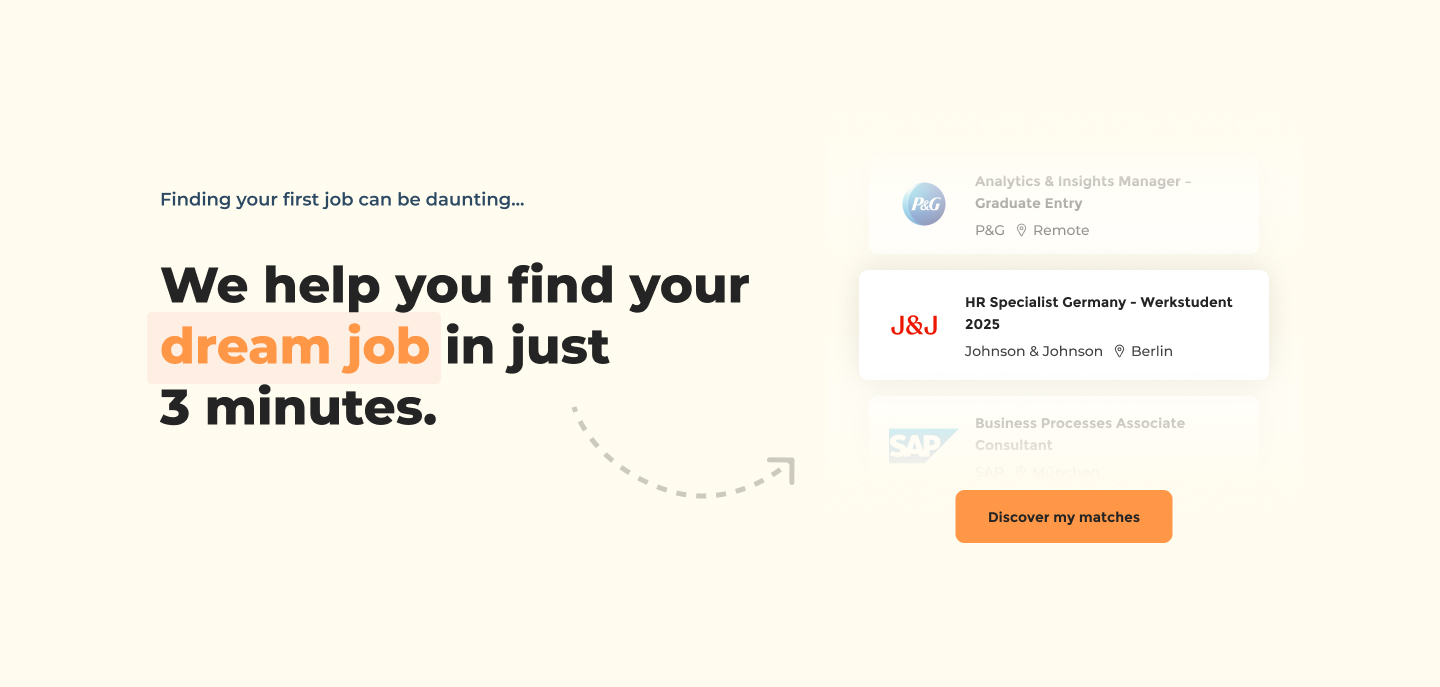

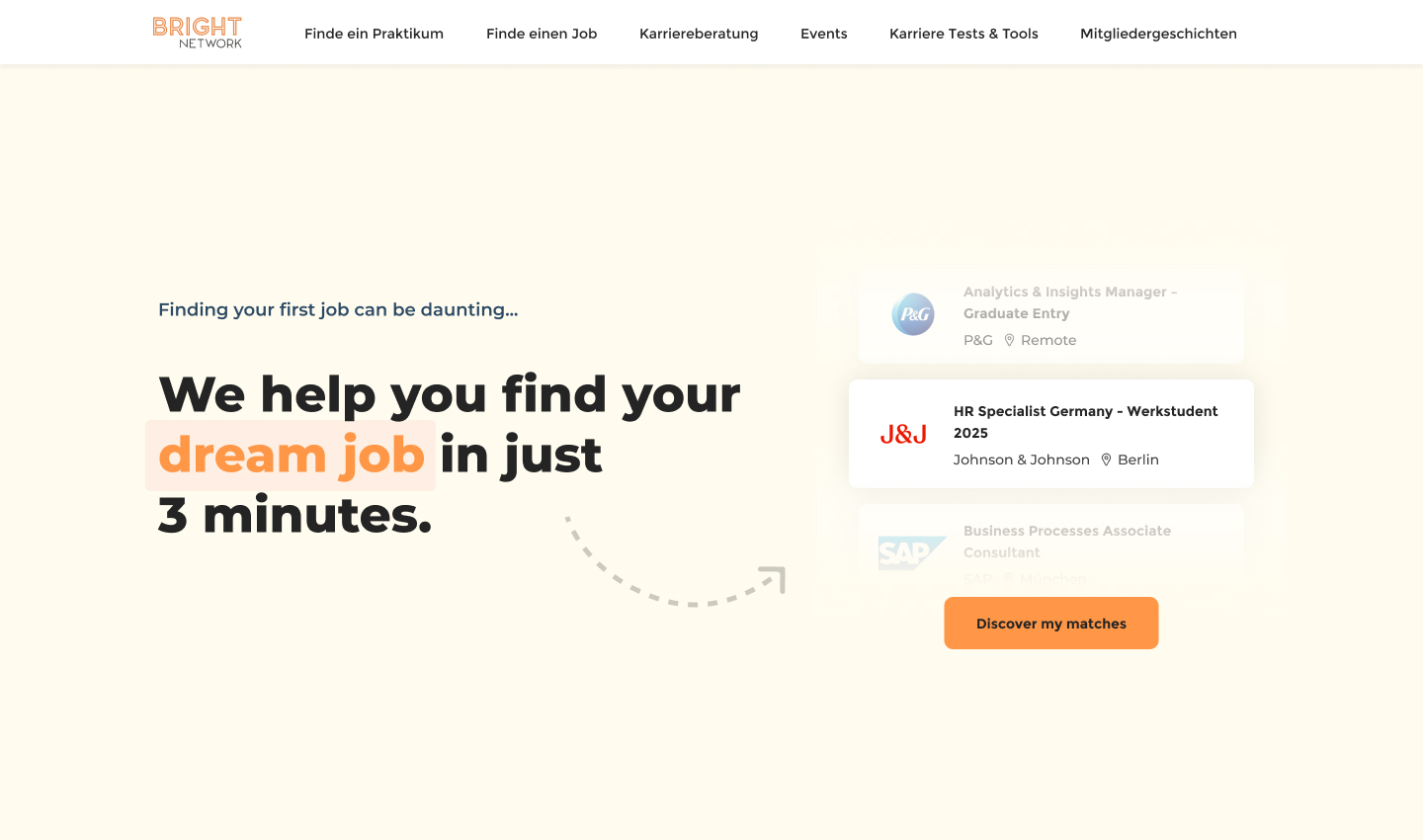
New homepage hero banner with animated carousel
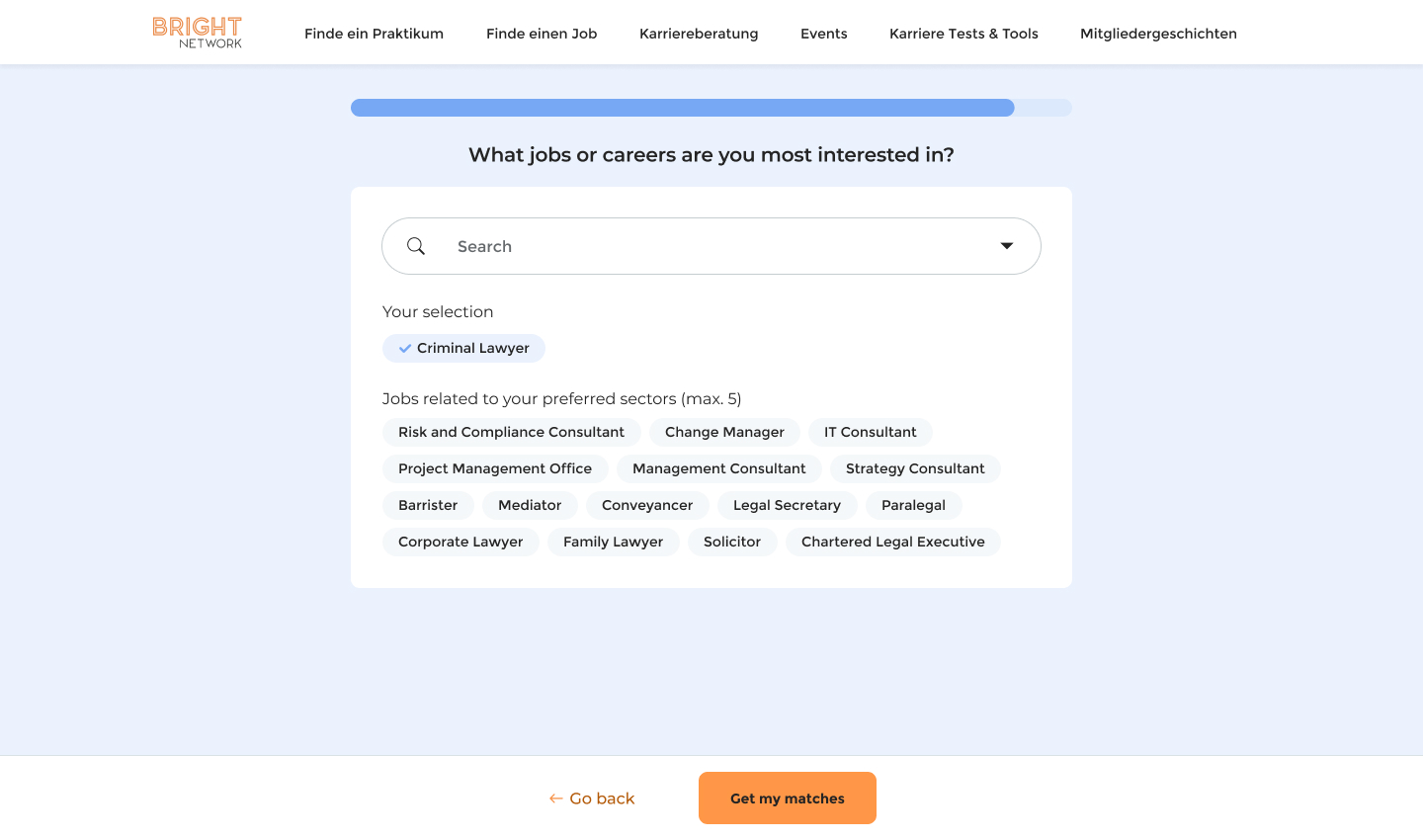
Short questionnaire showing final step question
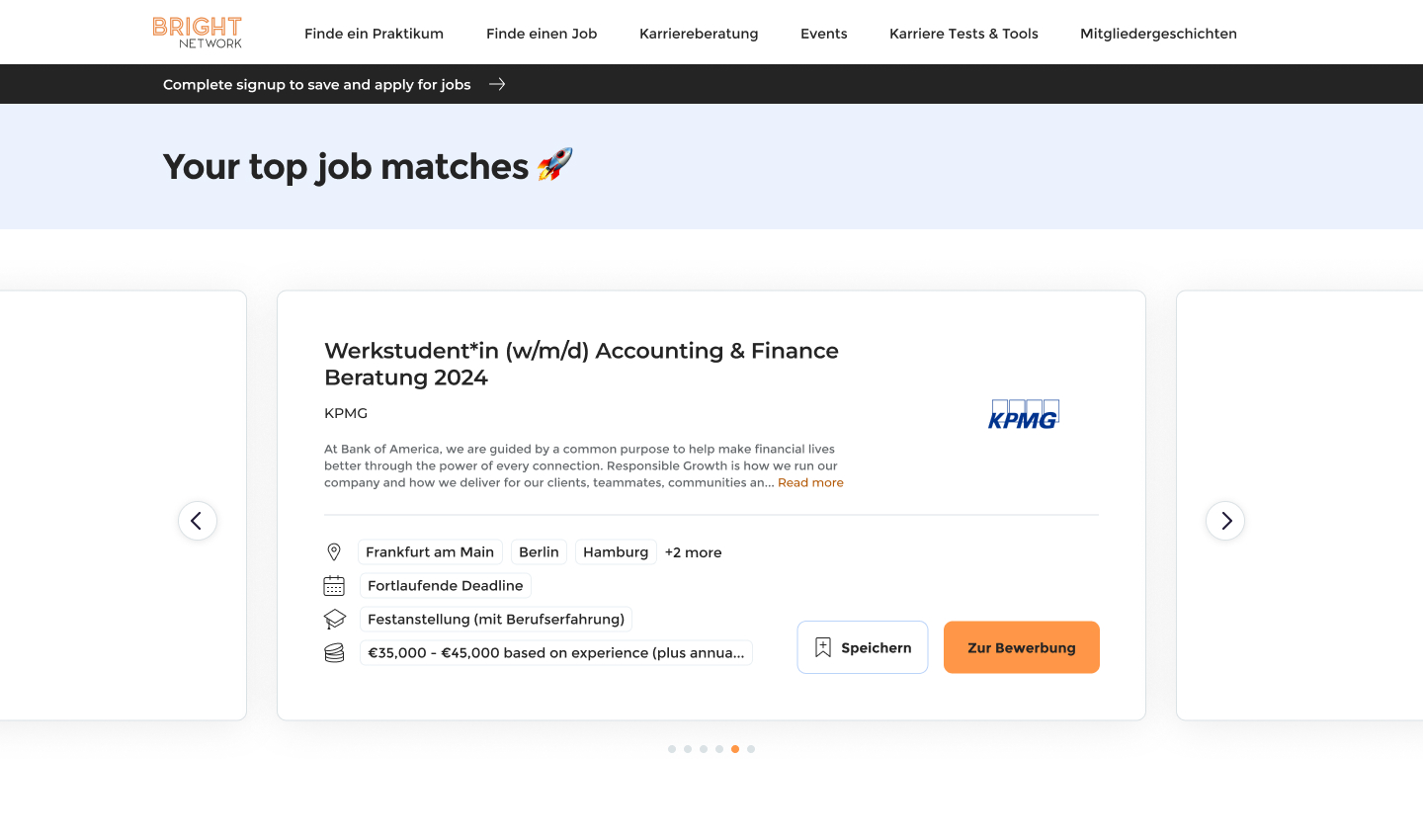
Job matches carousel
We introduced a new homepage hero banner to act as the entry point into this experience, with copy emphasising the short time commitment required to get started.
Users were then guided through a short questionnaire designed to understand their career interests, preferred locations, and desired job types, including “Werkstudent” roles to reflect local norms.
After completing the questionnaire, users were shown up to five tailored job matches. At this point, they were prompted to create an account to continue receiving recommendations.
Additionally, this solution could be built quickly using existing Bright Network technology, as it relied on repackaging current job data, filters, and search logic rather than developing new infrastructure.
Initial Testing
Before launching, we needed to validate two key assumptions:
- That the quality of the job matches would be high enough to encourage users to sign up
- That the overall concept would feel compelling and motivating
We conducted usability testing with six German students and recent graduates. During the first half of each session, I focused on validating job match quality using the live Bright Network website. For each session:
- I asked participants questions about their background and job preferences, mirroring the questionnaire used in the proposed designs.
- A German-speaking colleague observed the sessions and created filtered job searches on the live site based on each participant’s responses.
- These filtered job lists were then shared with participants for review, and I asked follow-up questions to assess relevance, interest, and expectations.
In the second half of the session, I ran a more traditional usability test using design mockups. This allowed us to evaluate the clarity of the copy, layout, interactions, and the overall concept.
"OK, maybe my dream job is not as far away and maybe I find something which I haven't seen before... three minutes isn't a lot"
•
German graduate, 29 yrs old, user testing interview
"I would need to go more deep in the jobs to decide, but the first impression is, yeah, I would apply for these jobs"
•
German graduate, 24 yrs old, user testing interview
The results were encouraging. We confirmed our hypothesis that German students would be motivated by this type of service, with all six participants expressing interest in the offering. Job quality was also validated, with five out of six participants receiving matches that felt relevant to their goals. Additionally, the user experience was generally understood without confusion, and no major usability issues were identified. Based on these findings, we felt confident proceeding with the launch.
Findings Post-Launch
Following launch, we evaluated performance against our original objectives. While we did not meet the target of 8,000 new members, the product attracted 2,580 new sign-ups within the first quarter. Although this fell short of expectations, post sign-up engagement significantly exceeded our goal, with engagement levels at least tripling compared to the previous year.
This demonstrated that while the concept resonated strongly with users who signed up, there was still work to be done to increase reach and conversion at the top of the funnel. As a result, we identified several next steps:
- Increase marketing activity and experiment with different creative approaches on social media
- Continue to improve job match relevance by moving from basic search logic towards a machine-learning-driven approach
- Test alternative onboarding “hooks,” such as requiring sign-up before showing any job matches.
Overall, this project highlighted the importance of market-specific research and reinforced that successful products cannot simply be copy-and-pasted from one region to another without adaptation.
2580
new members
3x
engagement on day 1
9x
engagement on day 7
Contact
Return to home
© Jo Watt
Going international: designing for the German Market
Introduction: Problem Statement
In 2022, Bright Network took their first steps toward international expansion by entering the German market. Germany was chosen due to a significant overlap in clients operating across both the UK and German markets, making it a logical next step for international growth. We launched the same product offering that had been successful in the UK, hoping the same would be true for Germany.
However, despite this strategic alignment, the launch did not attract the volume of German students and graduates that had been anticipated. Sign-ups and engagement fell well below expectations, indicating that simply copying the UK experience was insufficient for this new market. As a result, we needed to understand why the launch had underperformed and identify how we might better appeal to German students and graduates.
Our primary objectives were to increase the number of marketable members by 8,000 new sign-ups and to double post sign-up engagement.
Researching the German Market
At the point of launch, no dedicated research had been conducted into the German student and graduate market. To address this gap, we began by speaking directly with German students and recent graduates to understand their university education, work experiences, and career motivations.
Through user interviews and desk research, we learned that:
- Degree programmes in Germany typically last longer than in the UK, often spanning four to six years rather than three.
- ‘Werkstudent’ jobs are common which give students practical experience alongside their academic studies
- German students generally do not pay tuition fees and often receive government support to help cover living costs while studying.
To validate and broaden these insights, I also ran a survey sent to German students and graduates. This survey asked questions on job website expectations, the Bright Network brand and attitudes towards job searching in general.
- 0% were using Bright Network, and 75% assumed based on the name that it was a type of social networking platform
- 87% were happy to use competitor platforms like LinkedIn or Stepstone because they trusted their offering and liked the additional features such as online CVs, and direct lines to recruiters
- 56% wanted personal job recommendations based on their skills
- Most interestingly, we learned that 79% feel confident getting an entry level role after graduation (vs. 58% as we discovered through a different survey ran in the UK)
“I am not sure what my dream job is going to look like, but it would be nice to somehow get a job that fits my expectations right away.”
•
German student, 25 yrs old, user interview
These findings suggested a fundamentally different mindset. With less financial pressure and earlier access to relevant work experience, German graduates appeared to have greater freedom in their career decision-making. Rather than urgently applying for any available role, they were more focused on finding positions that aligned with their long-term goals, prioritising quality, relevance, and fit over speed. They were also happy with the current job platforms, so we needed to offer something unique in order to win this audience.
Proposed Solution
Based on our research, we proposed a new experience focused on surfacing a small number of highly relevant job matches tailored to each user’s profile. The goal was to immediately demonstrate value by showing roles that felt genuinely interesting and well-matched, encouraging users to register in order to receive ongoing recommendations.
This approach reduced the need for users to sift through long lists of irrelevant roles and allowed us to present more meaningful information at a glance. From a business perspective, it also helped convert anonymous visitors into registered users, enabling longer-term engagement and marketing.
New homepage hero banner with animated carousel
Short questionnaire showing final step question
Job matches carousel
We introduced a new homepage hero banner to act as the entry point into this experience, with copy emphasising the short time commitment required to get started.
Users were then guided through a short questionnaire designed to understand their career interests, preferred locations, and desired job types, including “Werkstudent” roles to reflect local norms.
After completing the questionnaire, users were shown up to five tailored job matches. At this point, they were prompted to create an account to continue receiving recommendations.
Additionally, this solution could be built quickly using existing Bright Network technology, as it relied on repackaging current job data, filters, and search logic rather than developing new infrastructure.
Initial Testing
Before launching, we needed to validate two key assumptions:
- That the quality of the job matches would be high enough to encourage users to sign up
- That the overall concept would feel compelling and motivating
We conducted usability testing with six German students and recent graduates. During the first half of each session, I focused on validating job match quality using the live Bright Network website. For each session:
- I asked participants questions about their background and job preferences, mirroring the questionnaire used in the proposed designs.
- A German-speaking colleague observed the sessions and created filtered job searches on the live site based on each participant’s responses.
- These filtered job lists were then shared with participants for review, and I asked follow-up questions to assess relevance, interest, and expectations.
In the second half of the session, I ran a more traditional usability test using design mockups. This allowed us to evaluate the clarity of the copy, layout, interactions, and the overall concept.
"OK, maybe my dream job is not as far away and maybe I find something which I haven't seen before... three minutes isn't a lot"
•
German graduate, 29 yrs old, user testing interview
"I would need to go more deep in the jobs to decide, but the first impression is, yeah, I would apply for these jobs"
•
German graduate, 24 yrs old, user testing interview
The results were encouraging. We confirmed our hypothesis that German students would be motivated by this type of service, with all six participants expressing interest in the offering. Job quality was also validated, with five out of six participants receiving matches that felt relevant to their goals. Additionally, the user experience was generally understood without confusion, and no major usability issues were identified. Based on these findings, we felt confident proceeding with the launch.
Findings Post-Launch
Following launch, we evaluated performance against our original objectives. While we did not meet the target of 8,000 new members, the product attracted 2,580 new sign-ups within the first quarter. Although this fell short of expectations, post sign-up engagement significantly exceeded our goal, with engagement levels at least tripling compared to the previous year.
This demonstrated that while the concept resonated strongly with users who signed up, there was still work to be done to increase reach and conversion at the top of the funnel. As a result, we identified several next steps:
- Increase marketing activity and experiment with different creative approaches on social media
- Continue to improve job match relevance by moving from basic search logic towards a machine-learning-driven approach
- Test alternative onboarding “hooks,” such as requiring sign-up before showing any job matches.
Overall, this project highlighted the importance of market-specific research and reinforced that successful products cannot simply be copy-and-pasted from one region to another without adaptation.
2580
new members
3x
engagement on day 1
9x
engagement on day 7
Contact
Return to home
© Jo Watt

Going international: designing for the German Market
Introduction: Problem Statement
In 2022, Bright Network took their first steps toward international expansion by entering the German market. Germany was chosen due to a significant overlap in clients operating across both the UK and German markets, making it a logical next step for international growth. We launched the same product offering that had been successful in the UK, hoping the same would be true for Germany.
However, despite this strategic alignment, the launch did not attract the volume of German students and graduates that had been anticipated. Sign-ups and engagement fell well below expectations, indicating that simply copying the UK experience was insufficient for this new market. As a result, we needed to understand why the launch had underperformed and identify how we might better appeal to German students and graduates.
Our primary objectives were to increase the number of marketable members by 8,000 new sign-ups and to double post sign-up engagement.
Researching the German Market
At the point of launch, no dedicated research had been conducted into the German student and graduate market. To address this gap, we began by speaking directly with German students and recent graduates to understand their university education, work experiences, and career motivations.
Through user interviews and desk research, we learned that:
- Degree programmes in Germany typically last longer than in the UK, often spanning four to six years rather than three.
- ‘Werkstudent’ jobs are common which give students practical experience alongside their academic studies
- German students generally do not pay tuition fees and often receive government support to help cover living costs while studying.
To validate and broaden these insights, I also ran a survey sent to German students and graduates. This survey asked questions on job website expectations, the Bright Network brand and attitudes towards job searching in general.
- 0% were using Bright Network, and 75% assumed based on the name that it was a type of social networking platform
- 87% were happy to use competitor platforms like LinkedIn or Stepstone because they trusted their offering and liked the additional features such as online CVs, and direct lines to recruiters
- 56% wanted personal job recommendations based on their skills
- Most interestingly, we learned that 79% feel confident getting an entry level role after graduation (vs. 58% as we discovered through a different survey ran in the UK)
“I am not sure what my dream job is going to look like, but it would be nice to somehow get a job that fits my expectations right away.”
•
German student, 25 yrs old, user interview
These findings suggested a fundamentally different mindset. With less financial pressure and earlier access to relevant work experience, German graduates appeared to have greater freedom in their career decision-making. Rather than urgently applying for any available role, they were more focused on finding positions that aligned with their long-term goals, prioritising quality, relevance, and fit over speed. They were also happy with the current job platforms, so we needed to offer something unique in order to win this audience.
Proposed Solution
Based on our research, we proposed a new experience focused on surfacing a small number of highly relevant job matches tailored to each user’s profile. The goal was to immediately demonstrate value by showing roles that felt genuinely interesting and well-matched, encouraging users to register in order to receive ongoing recommendations.
This approach reduced the need for users to sift through long lists of irrelevant roles and allowed us to present more meaningful information at a glance. From a business perspective, it also helped convert anonymous visitors into registered users, enabling longer-term engagement and marketing.
New homepage hero banner with animated carousel
Short questionnaire showing final step question
Job matches carousel
We introduced a new homepage hero banner to act as the entry point into this experience, with copy emphasising the short time commitment required to get started.
Users were then guided through a short questionnaire designed to understand their career interests, preferred locations, and desired job types, including “Werkstudent” roles to reflect local norms.
After completing the questionnaire, users were shown up to five tailored job matches. At this point, they were prompted to create an account to continue receiving recommendations.
Additionally, this solution could be built quickly using existing Bright Network technology, as it relied on repackaging current job data, filters, and search logic rather than developing new infrastructure.
Initial Testing
Before launching, we needed to validate two key assumptions:
- That the quality of the job matches would be high enough to encourage users to sign up
- That the overall concept would feel compelling and motivating
We conducted usability testing with six German students and recent graduates. During the first half of each session, I focused on validating job match quality using the live Bright Network website. For each session:
- I asked participants questions about their background and job preferences, mirroring the questionnaire used in the proposed designs.
- A German-speaking colleague observed the sessions and created filtered job searches on the live site based on each participant’s responses.
- These filtered job lists were then shared with participants for review, and I asked follow-up questions to assess relevance, interest, and expectations.
In the second half of the session, I ran a more traditional usability test using design mockups. This allowed us to evaluate the clarity of the copy, layout, interactions, and the overall concept.
"OK, maybe my dream job is not as far away and maybe I find something which I haven't seen before... three minutes isn't a lot"
•
German graduate, 29 yrs old, user testing interview
"I would need to go more deep in the jobs to decide, but the first impression is, yeah, I would apply for these jobs"
•
German graduate, 24 yrs old, user testing interview
The results were encouraging. We confirmed our hypothesis that German students would be motivated by this type of service, with all six participants expressing interest in the offering. Job quality was also validated, with five out of six participants receiving matches that felt relevant to their goals. Additionally, the user experience was generally understood without confusion, and no major usability issues were identified. Based on these findings, we felt confident proceeding with the launch.
Findings Post-Launch
Following launch, we evaluated performance against our original objectives. While we did not meet the target of 8,000 new members, the product attracted 2,580 new sign-ups within the first quarter. Although this fell short of expectations, post sign-up engagement significantly exceeded our goal, with engagement levels at least tripling compared to the previous year.
This demonstrated that while the concept resonated strongly with users who signed up, there was still work to be done to increase reach and conversion at the top of the funnel. As a result, we identified several next steps:
- Increase marketing activity and experiment with different creative approaches on social media
- Continue to improve job match relevance by moving from basic search logic towards a machine-learning-driven approach
- Test alternative onboarding “hooks,” such as requiring sign-up before showing any job matches.
Overall, this project highlighted the importance of market-specific research and reinforced that successful products cannot simply be copy-and-pasted from one region to another without adaptation.
2580
new members
3x
engagement on day 1
9x
engagement on day 7
© Jo Watt